Tag Archives: writing

It’s World James Bond Day!

It’s World James Bond Day! And, as somebody who was never the same again after watching The Spy Who Loved Me and You Only Live Twice. I couldn’t let it go unmarked. OK so StarWars played a big part too, or at least the fact I saw The Spy Who Loved Me and the first StarWars film, pretty much back to back.

However, this is World James Bond Day so we won’t complicate things with StarWars, suffice it to say that I would probably write historical novels if I hadn’t witnessed George Lucas’ clever way of getting sword fights, which are, after all, BRILLIANT, into a sci-fi film. OK back to the programme… World James Bond Day.

The Spy Who Loved Me is not the best Bond film but it’s the first grown up film I saw, in a cinema… in Norwich, believe it or not. And it had that big base… with all the stuff… and of course… THE LOTUS.

Yes, THIS Lotus. Thank you instableblogsimages.com for the picture.

Let’s face it, that’s a snurd in submariner mode. Proof positive that I didn’t really invent them. Sorry about that. So for all my policy of only writing about things I’ve made up (so nobody can send me an irate e-mail saying ‘how dare you! You’ve got dwarves COMPLETELY WRONG!’) snurds, or at least the idea of cars that fly, go under water, turn into boats, shoot guns, blow caravans out of our path and other things we wished they do, is pretty much public domain. Snurds are just my version.

So after the StarWars Spy Who Loved Me combo, my dolls were suddenly spies with a space base. Imagine how overjoyed my Mum was when she examined the Pippa space ship I’d been taking to school for a week close up and discovered that in pride of place, as the central control panel, was the used Monday-Tuesday-Wednesday-etc blister pack from her contraceptive pill. Suddenly I was gluing wings on my toy cars, buying airfix models of cars and aeroplanes and melding them into… well, yes, even then I called them Snurds.

Every day as I sat, in my Mum and Dad’s classy Peugeot 304 (don’t knock ’em they were brilliant) in the Worthing rush hour traffic (yes, we have rush hour in Worthing) on my way to school, I fantasised that it was Emma-Peel-Lotus-shaped and we were sprouting wings, executing a vertical take off and flying away. I suppose where I differ is that I did expect, at some point, to grow out of fantasising about snurds. But fortunately it never happened.

The year I saw The Spy Who Loved Me was also the point at which I found an old box, wrote “Lotus” on it in biro and started saving up for one. I wanted one of these.

Or do I mean these…?

I finally achieved my dream when I was 33. Sadly, in 11 years, I failed to access the All Purpose Torpedoes and I never found its wings button. I’ve just traded it in for a new one, although I’m afraid, so far, that one doesn’t seem to have a wings button, either.

Lotus Engineering, are you listening? You really need to make a snurd.

If you really like them, you can purchase snurd-related merchandise – and K’Barthan-related but let’s face it, the snurds are the best bit. It includes t-shirts, hoodies, mugs, post cards and the like from www.zazzle.co.uk/drawnbyhand*

2 Comments

Filed under About My Writing, General Wittering, Humorous Fantasy Author

Publishing is dead: Long live… publishing?

What does a publisher do? Is there a point to having one? As a species are publishers dead?

I was just looking at this and even though I’m self published, I agree with pretty much all of it.

So… reading that kind of bears out what I’ve always thought. Ergo that a publisher is something akin to a venture capitalist. They see an idea and they invest. After a number of funding rounds etc, the ‘inventor’ of a product usually ends up with around 10% although I know people who have ended up with about 2%. When a company you started sells for several hundred millions and you get a ‘mere’ two it could be galling, if you looked at it the wrong way. But, in many cases, without the expertise of the Venture Capitalists – sorry I think they call themselves Business Angels these days – that hundreds of millions sale may not happen. Inventors invent something but as I understand it, where they make the money is sharing their know how with, and investing in, like minded individuals afterwards.

So what I’m saying, inarticulately as usual, is, writers have an idea, the publisher is the venture capitalist in that they pour thousands into the venture to get it to the stage where it will start making a return. The writer who has a publisher gets 10% rather than 70% but they will probably get to a break even point quicker than they might otherwise. Well… unless they live on benefits and spend all day every day marketing their work online and elsewhere. The other 60% absorbed by the publisher has probably been spent on design of the book and cover, some marketing, paid reviews in the right places and the kind of contacts and clout that no self published author will have. In short, if you’ve written, something, anything marketable, a publisher is the best bet (or acting the EXACT same way as a publisher – apart from saying no to yourself, obviously).

Unfortunately publishers are not like VCs or BAs, they’re much more cautious about who or what they invest in and there seems to be a lack of creative flair among the big ones. That means a lot of good stuff gets left on the cutting room floor… or the author may have some home life reason that precludes them from writing two books a year – which is what any self respecting publisher will expect (and need).

Those are the people who are going to have to do their own thing and those are the people whose books WILL get written, whatever the article says, and will get published. None of my stuff would ever see the light of day if I had to sell it to a publisher first. That’s partly because I’m bollocks at sales but a big bit is also because I have too much on in my real life to write a book in under 18 months. Even with an advance I couldn’t do that because the sticking points are people who need me, my time and my… well it sounds corny but… love.

So, if publishers could accept China Mieville’s view: “If we try to second guess readers, it’s a fool’s game. Our job is not to give readers what they want, but to make readers want what we give.” it would be great.

Unfortunately a lot of the big ones are trying to second guess what readers want and give it to them. The result is a huge restriction on choice and creativity.

Hang on though! Lots of small publishing houses have appeared in the last few years who are bang in line with Mr Mieville and have stepped into the breach. At this rate the publishing industry will re-invent itself… as it’s old 1960s forward looking, inquisitive, quality driven self.

Let’s hope so.

Leave a comment

Filed under e-publishing, General Wittering, Interesting

Have a look at my box. Phnark

OK, seriously then. There’s a little box to your right labelled, “UK Amazon Kindle Webring”. This is a group of websites from the users of a group on Goodreads called the UK Amazon Kindle Forum – now there’s a surprise.

Anyway, you can find the group here

If you’re a British author I can recommend joining. There are lots of really useful forums on the internet where you can ‘meet’ and ‘speak’ to other authors but many of them are American sites, and while there are lots of lovely people on them, they do tend to be so terribly high-minded and serious. So, if you want a bit of levity as well as excellent book recommenations, information, interaction with readers and other authors etc the UK Kindle Forum is a good place to go.

Plug over then. Apologies, I am blitzed. McMini put olbas oil in his eye on Friday night – nimble fingers and an enquiring mind; a dangerous combination. I rinsed his eye thoroughly but we still ended up in casualty. They were great; saw us very quickly and we were home by 9pm but I’m amazed how knackered an hour or two spent worrying whether your son has irreparably damaged his sight in one eye makes a person.

We have now completed the course of eye cream and in return for his bravery I will now have to purchase him a Spiderman T-shirt. Note to prospective parents, bribery works well on small children.

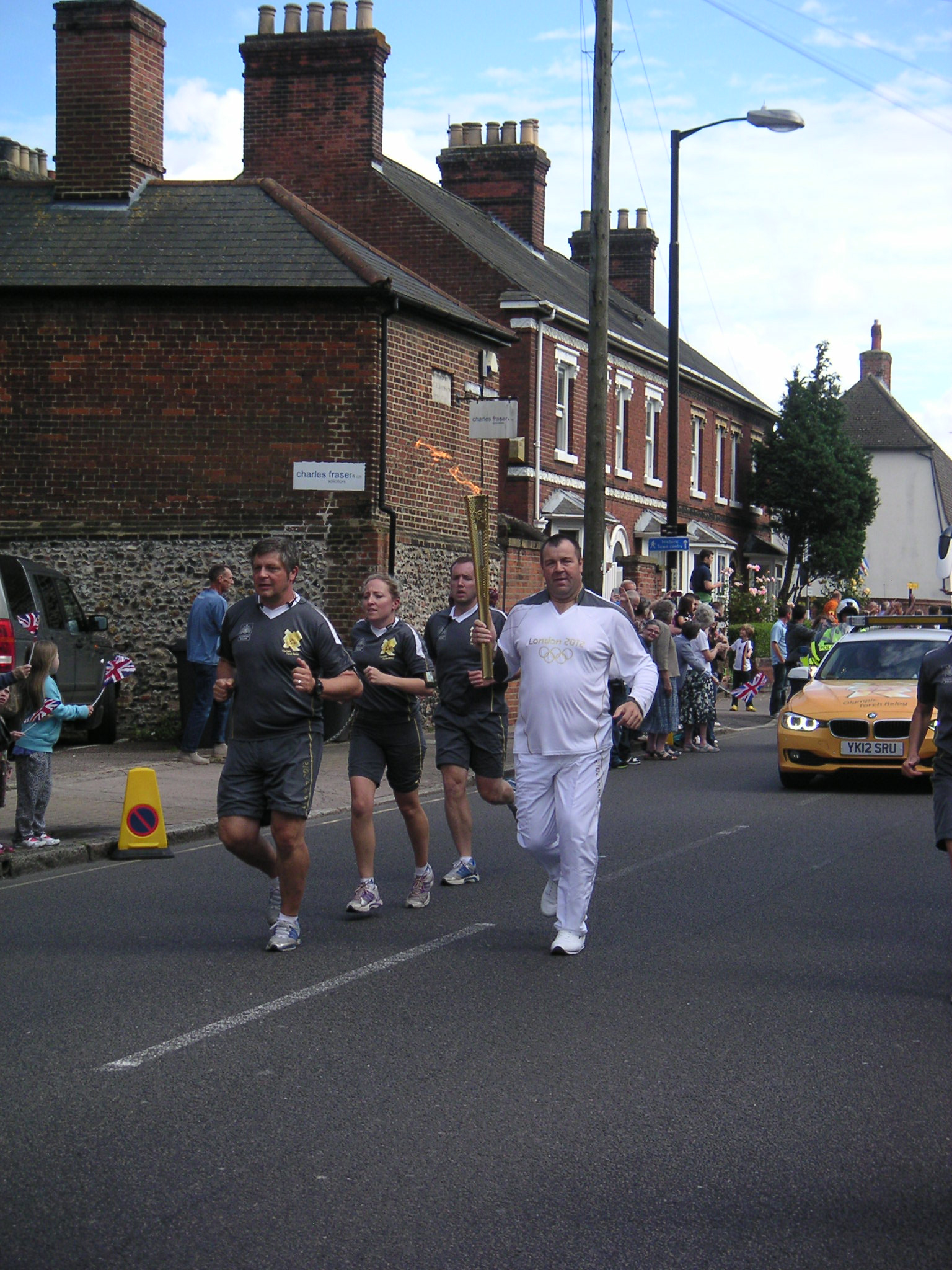
On the up side the olympic flame went past our house yesterday and I even managed to take a picture. See below.

Olympic Torch: Bury

The Olympic Torch goes past my house.

Marvellous.

2 Comments

Filed under General Wittering

Why Can’t Indies Punctuate Dialogue? I Think I Know.

Gah, welcome to the world of Victoria Meldrew. I was reading a post on a forum somewhere recently, complaining that self published authors are rubbish at dialogue. Well, sticking my neck out, I’ve just discovered a lot of my dialogue tags are wrong.

So once again, I am at home to Mr Cock up. Frankly, he’s going to be moving in at this rate. I dunno what’s wrong with me at the moment. I seem to be dead from the neck up.

So, now that I’ve bombed, I may as well tell you what I’ve learned so you don’t have to.

At school – and sodding heck, it’s only 20 years ago – I was taught to write dialogue like this:

“Writing speech is a pain in the arse.” Said M T McGuire.

Sometime, between me leaving school and starting to write books for a living it changed to this.

“Writing speech is a pain in the arse,” said M T McGuire. “Never mind. On the up side, entirely fortuitously it’s right in book two.”

So here’s what Mr Cock up has taught me on my latest visit.

Golden Rule Number 1, then: Even if you left school five minutes ago, question the rules of punctuation you were taught.

After all, you only have to look at how often government policy on education changes to realise that the shelf life of any received theories propounded to you as a child, will probably be out of date before you leave school.

So yes, I’m afraid those rules of grammar that it hasn’t occurred to you to doubt may be completely at odds with the way things are done now. And if they are, you will be looking like a spanner. NB, even if you write business English for a living, check the types of grammar you don’t use in your every day job that you will use in a book. Like speech! Gaaaah.

Can you guess who didn’t do this? For heaven’s sake, I have a very high IQ – I really should be smarter than this. It’s a bit like being one of those people who can build something really pointy-brained, like a satellite, but can’t boil a kettle… except that I haven’t got any satellite-building abilities against which to offset my piss-poor kettle boiling skills.

Bum.

Oh well, on we go.

Golden Rule Number 2: Don’t trust the internet.

Having realised I may well have ballsed up a lot of the dialogue tags in all my work, I tried to find out what was the right way on the internet. All I could really discover is that one, there is a lot of disagreement and two, none of it looks like the way I was taught at school.

You can google a lot of things but not grammar. There are too many strains of English round the world and not everyone knows which is which. Hmm… Which leads me onto number three.

Golden Rule Number 3: Ask the right questions.
Because I remembered what I’d been taught it didn’t occur to me to ask at first but when I saw what the editor had done, and failed to understand what was going on, I did ask her. The answer she gave was that I should treat the whole thing, speech and tag, as a sentence. That was right but it still gave me plenty of scope to do it like this.

“Punctuating dialogue drives me crazy.” said M T McGuire.

Which is still wrong, wrong, wrong.

Golden Rule Number 4: Ask the right people.

I now use a different editor who is pretty good. I was still confused when I first started working with him though. So why didn’t I ask him? I haven’t a blind clue. So when you find someone who knows what they’re doing and you trust ask them. If you can find somebody who is absolutely pukka writing, trad pubbed establishment ask them too.

Golden Rule Number 5: Always be open.

One day I might get this writing thing sussed but I suspect not. Language is a living thing. It’s always going to move and change. So even if you begin to think you know what you’re doing it’s worth remembering that actually, you may not.

Which brings me onto the 6th rule.

Golden Rule Number 6: Always use an editor.

This is really important. Seriously. Unless you are some kind of grammar savant, use an editor. Hell, use two. I do… and beta readers and I’ve still stuffed up. Ninety nine point nine percent of authors cannot proof their own work. Trust me on this. Get somebody else to do it. Then if you have any gimlet-eyed reader friends, get them to look at it.

Golden Rule Number 7: Keep an eye on what you learn.

As you learn more your work will get better and your punctuation more professional. Each work you produce is a shop window on your talent. If the punctuation is a bit dodgy, or old fashioned, it doesn’t reflect well on you so if you learn something new that hits you out of the blue or change the way you punctuate, I dunno, interrupted speech or something, remember to apply it retrospectively to all your work. Not just the one it’s cropped up in.

Sure your skill with the business of arranging words will grow but so will you knowledge and while your actual writing style may change, editorially continuity is best – a house style if you like.

So there you go, in a nutshell, think about what you’re doing. Always.

I hope that helps.

2 Comments

Filed under General Wittering, Other Creatives, winging author

The Overnight Success Myth and Other Stories…

I’m not sure why this has come up now but I’ve found myself discussing the hard work aspect of becoming a writer quite a lot over the past week.

Also, with the attitude of some independent authors and the hardening attitude among readers it has caused, I am beginning to wonder whether self publishing is quite such a smart option. It’s definitely right for me at the moment, but long-term smart? I’m not sure.

Run with me on this, eventually the two thoughts will connect.

Reading the results of the Taleist survey of indie authors, I was interested to see that some ludicrously high percentage of independenly published books – about 75 I think – are fantasy. I’m not sure this reflects the number of fantasy writers out there so much as the number of publishers willing to take them on. Certainly there were very few in 2009 when I was looking at the traditional route and of the few prepared to read a fantasy manuscript, even less, would look at a funny one.

However, whichever way you cut it, it means that any fantasy writer who does decide to look for a publisher will have a lot of competition. In regard to my own work, the standard doesn’t worry me, but setting my talent (or lack of it) aside for a moment, there are a lot of aspects, beyond my control, that make someone like me an unattractive prospect to a publisher. So if you’re grappling with the self or pukka publisher question here are four reasons to think about self publishing over and above the usual ones.

If you take a long time to write a book.
Going on my own experience here, the way I see it is this: If I go on sending my work to publishers for long enough the law of probabilities states that it will click with somebody – but with my business hat on, I can’t help wondering about the other criteria. You see if I was a publisher, I’d be looking for more than just talent, I’d be looking for commitment and that’s where I fall down. Big time. I already commit most of my spare time to being a writer and it’s about… er hem… 10 hours a week. I have the odd weekend, too, so I could score a Saturday book signing every now and again but I would probably have to attend with a small boy (four tomorrow).

Looking at the early Pratchett model, I reckon you have to be able to write a decent book every 6 months at the outset to keep up momentum and to keep your readers – not to mention your publisher – interested. It costs a lot of money to publish a book and until you have written a few of them, the Publisher isn’t going to get much back. So, if it takes you longer than 6 months to write one I reckon you have two options. Publish them yourself or stockpile a few manuscripts that are ready to go before you approach a publisher. Think about it from their point of view, if they like your work that’s good but if you’re prolific you will deliver a return for their investment more quickly. That might be the difference between their giving a contract to you or to someone else.

If marketing your book will get in the way of writing the next one.
One of my author friends is doing a book signing somewhere in the UK on all bar 4 weekends this year. That’s seriously impressive. If anyone deserves to be an ‘overnight success’ it’s this guy but that’s the level of commitment it takes. It’s the level of work I would aspire to if my circumstances were different, in fact I’m kind of envious of him. Oh alright, I’m very envious, positively seething, but I digress.

If you do have a publisher, marketing your book is almost more important than when you self publish. How so? Because they have put their faith in you and if you have any scrap of self respect or honour in you, you won’t want to let them down. You will have to be involved in a very hands-on way with selling your book. So there are two things to think about there. First, even if you want to put in that kind of commitment, can you? If you can’t, will you feel bad about letting your publisher – or yourself – down or feel pressured that you’ve found a publisher and shouldn’t waste your opportunity. This is one of the big factors in my decision to self publish. It’s also why I believe I will have to demurr from chasing establishment endorsement for a couple more years.

Do you need to balance the proportion of your time you spend positively?
Getting said ‘no’ to on a semi-professional basis can be soul destroying. You are probably different to me but going on the vast difference between my ability get a job and my ability to actually do one, I should think it will take me well over 100 rejections before I get a reply from anyone – let alone a yes. I might be able to handle that if I send out my applications in batches. However, there’s a catch. Sure, most publishers want the same kind of things but each one wants them presented just differently enough to ensure that a merge file won’t cut the mustard.

Publishers are getting hundreds of letters from people like you and me every day. Jumping through the hoops the way they want you to is very important. Do it wrong and your application will be filed under ‘B’ straight away. So by the time M T McSpacker, here, has checked and re-checked each application, that’s going to be my 10 hours for the week, and probably my 10 hours for the next week, too. What I’m trying to say is that right now, that’s a daunting amount of work to put into a very negative process. Yes, getting politely and repeatedly slapped down – even if the eventual outcome might be positive – is grim. It’s self indulgent and whimpy of me but I just don’t have enough spare time or confidence to use that much of it, that way, at the moment.

Don’t be afraid of getting left behind.
Kind of an about turn after some of the things I’ve been saying but still important. The hardest, hardest thing to do but very important or you’ll burn out and go mental. You have to take this stuff at your own pace. If you aren’t able to achieve something right now, for whatever reason, relax and concentrate on the things you can achieve.

For me, the publisher question will not go away. It’s good to have the endorsement of a gatekeeper and it’s good for your confidence as a writer. I believe in my stuff or I wouldn’t ever have found the balls to publish it myself. However, I see a little gap in my confidence, a tiny doubt, that will never go away without establishment endorsement. And I see the headway I make trying to get it into brick and mortar bookshops. And I think. Ah.

Hopefully, anyone who does the self publishing thing properly, me included, is going to learn things in the process. Things that may well increase their marketability to a publisher. After all, if you can show some empathy with their viewpoint and the challenges they face, it’s got to help. Maybe, if I understand a bit more about what publishing is about it will make up for the lack of time I have for both writing and marketing.

So, I’ve set myself a realistic target. When the next Writer’s and Artist’s Yearbook comes out (2013). Then, if the publishing world is still the way it is now and if my world contains more time, I will spend one day a week on getting a publisher. And I will write to every British Fantasy publisher in that ruddy book until I can bludgeon one of them into saying yes to me.

Until then? Well, I’ll ignore it and hope it’ll go away. I never said I was brave did I?

Leave a comment

Filed under About My Writing, Finding a publisher, General Wittering

Talking about unblocking drains…

How do you unblock a writer?

Things are hectic here at Casa McGuire with a flotilla – or is that a crack – of plumbers, jubilee cakes to make, a birthday party to organise and a very lively three year old to amuse. This does not make for an easy time plotting a book – a fairly cerebral process which takes a great deal of mental application and energy… neither of which I have, just ideas. In abundance. Which is tricky.

When it’s all go and it’s lovely I’m a great believer in giving up and enjoying it. The grey matter should not be forced. So for me right now, it’s a case of tinkering. A sentence here and there, a joke, a bit of conversation. If the brain can’t cope it’s a case of letting it put its feet up and leaving the subconscious get on with it. Sure it’s frustrating but it’ll happen, and probably a lot faster than if I flog my extensively plutzed grey matter.

Meanwhile, I’ll work on something else… unless I’m too blitzed to write at all. In which case, I’ll stop.

So there we are. Difficult things to learn about writing number 63: knowing when not to.

As if to bear me out, when I click post, WordPress gives me a quote from Agatha Christe.

“The best time to plan a book is when you’re doing the dishes.”

Leave a comment

Filed under General Wittering, Good Advice

Is ‘indie’ the new ‘crap’?

Is there still a stigma attached to self publishing?

As an indie music fan, I have always associated the word ‘independent’ with quality. People who have ploughed their own furrow, refused to compromise their artistic integrity and done their own thing. Indeed, I’ve never been a great fan of mainstream music dismissing pretty much the entire lot of it as overproduced shite. The big exception here being Abba and 1960s bubblegum pop but cut me some slack there, everyone needs to flirt with the Dark Side sometimes.

Imagine my surprise, then, to discover that in the world of literature, the word ‘independent’ in many circles is synonymous with the word ‘crap’. Even worse, it can also mean, giant-egoed, self-important drama queen… with delusions about their talent (please god let that not apply to me).

I don’t want to sound chippy but self published authors do seem to be pretty much the literary equivalent of ear wax. Worse, I get the impression that, in many quarters, if it came down to a popularity contest between the two, the ear wax would win.

Then, we move further out to extremes and we have these people who have worked themselves up into a frothy-mouthed frenzy of loathing at the idea that anyone should dare to publish their own book. These people seem to be determined to exterminate any literature which has not been chosen by the beloved gatekeepers from the public domain. I reckon they probably work for them.

So first up. The indie bashers. What I’d really like to know is how these people buy books?

I mean, when I buy a book I go into a shop and have a leaf through and if it looks interesting I buy it. On Amazon, I go to the page, have a look at the preview or download a sample and read it. If I like it I buy it. So when the indie bashers take a break from stalking the Amazon forums, axe in hand, like Jack Nicholson in the Shining, looking for indie authors so they can kill them, what are their book selection criteria?

Clearly they don’t buy them the way I do or surely they’d spot the duffers on the first or second page of the sample. Instead, it seems they purchase without looking so they can be shocked and irate and feel cheated when a book turns out to be crap.

Why does this piss me off? Well mainly because I’ve waited to publish until I’ve written a reasonable book. I’ve had it proof read by professionals. I’ve had a proper cover designed by professionals. I’ve attempted to produce a book which looks and feels professional to the reader and it got an award so it must be reasonably decent. I’m not the only one self publishing who has bothered to do this, there are lots of others. Unfortunately we get lumped in with those selling dross with the aplomb and sensitivity of door to door double glazing salesmen.

However, don’t get smug, indie writers. If the people who are pathologically unable to spot a good book seem thick, you, my fellow authors are the dumbest things that ever walked the earth. With the brains-to-body ratio of a triceratops (look it up) and a sense of self preservation that would make it look smart for Lady Ga-Ga to wear her meat dress in a shark tank.

Oh yes, a lot of you really do seem to be intent on shooting yourselves – and me with you, you smeckers – in the foot. Yeh, I’m raw about it this week.

So here are some please-oh-please-I’m-begging-will-you-fricking-do (and-do-nots) for anyone thinking about publishing their own novel.

1. ‘Wait it is not ready yet’ The Grolsh Novel.
You’ve managed to write 70,000 words with a beginning a middle and an end.

Well done.

Here’s the big news. This is where the hard work starts. Avoid being Grolsch author. If this is your first ever novel, the chances are, ‘it is not ready yet’. Think before you go ahead and publish anyway. Trust me on this, I’ve written three Grolsch books. I really, really wanted each one to be THE ONE but it wasn’t. It took every fibre of self control in my body to demurr from publishing them but I did. Trust me, if I can do it, you can. Experience has now proved that, had I published any of them, I would have destroyed my credibility as a writer and made selling subsequent books that bit harder. I am very, very glad.

2. Think about production.
If you’re going to write a book, do it justice. Spend money on a professional proof reader. Also, don’t get it proofed on paper, trust me, you’ll put more mistakes in than you take out. Er hem, I did anyway. Have it proof read by somebody who will make the changes in the document. Get a decent cover designed by someone who knows what they’re doing. Find out what fonts are popular with publishers, find out how books are formatted and laid out, justification, chapter headings etc.

3. Try to avoid making assumptions about your audience. It’s dangerous.

Some of the things I’ve seen indie authors do on forums are, frankly, prepscholic. Pretending to be other people and bigging up their book, making fake accounts and writing pretend five star reviews. The average 10 year old would consider these moves unsophisticated and beneath them.

This behaviour is very unwise, my paduan learner.

And it’s cheating.

Furthermore, every single one of those bogus reviews chips another tiny piece off the genuine reviews and hard earned reputation of those of us who do have some integrity.

It’s also worth asking family and friends to admit their connection.

4. Avoid ‘exchanging reviews’.
I am pretty gutted when authors offer to ‘review’ my book and give it 5 stars if I do the same in return. No. I’ll review a book and give it however many stars I think it’s worth. Gushing about books you’ve never read or that you’ve enjoyed less than you say damages the integrity of the whole system. It also damages the credibility of genuine, honest review groups.

5. Avoid spamming.
If you drop a 3,000 word essay about how wonderful your thriller is into the middle of a thread about teacups you are going to turn people off. They’re going to remember you as that person who turned up without so much as a nod to the topic under discussion, or even a hello, shouted in their faces for a few moments and then effed off into the ether, never to be seen again.

Are they going to read your book?

No.

6. Make it perfect.
That’s right. You have to, because unfortunately, there are a lot of people self publishing things that shouldn’t see the light of day. That means that even if your book is alright, the automatic assumption of a big part of your audience is going to be that it’s crap and that you are a git. So you almost have to make a better job of it than a ‘proper’ publisher would.

7. Be confident – but not arrogant.
So many people knock self publishers that, if you are one, it’s easy to take it to heart. Also, if you don’t have that vote from a ‘gatekeeper’ it can make believing in your stuff and publicising it very hard. So try not to over compensate. If you’re publicising on forums, I’ve found the best way is to ignore the fact you’re an author for some time and just chat to people. Like real life, you can tell people what you do when you get to know them.

8. Be courteous and professional.
If someone doesn’t enjoy your book it’s allowed. Don’t get into a public shit fight if someone gives it a bad review. Indeed try to avoid shit fights at all.

To sum up, make sure your book is ready, present it and publish it as well and professionally (I hate that word but I can’t think of any other way to say it) as you can. And once it’s out there, behave with integrity and courtesy. In other words, research what your publisher would do, if you had one, and do the same thing only better.

Leave a comment

Filed under e-publishing, Other Creatives

The Value of Re-reading…

Hmm… here I am formatting my book for print, ordering actual bound copies to look at and evaluate and thinking that I am pretty much finished when I discover a massive and pointless continuity error…

I’d never seen it before so I’m delighted (not to mention relieved) to have found it now.  I suspect the moral of this story is that you can never proof read your stuff enough times.

On a completely different subject, the p key on my computer has broken. It still types, but the plastic lid won’t stay on so I have to put my pinkie directly onto the strange squishy rubbery mechanism… I guess the moral of this story is not to put your computer on the ground so your mobile phone falls out of your pocket onto the keyboard when you stand up.

Another small disaster was averted, too, yesterday when scion came rushing through my nice clean house shouting “egg” and juggling a real one from hand to hand – he is one and three quarters so this was… alarming. I did manage to rescue it and get it back into the pantry… I also managed to rescue the three other eggs he had dropped into the cereal box. Luckily none of them broke either… so no eggy cereal and no horrible eggy goop stuck, for ever, between the floor boards in the hall!

Points to the little one for manual dexterity, too, he’d unhooked and opened a wire egg basket and opened a cardboard egg box inside it.

2 Comments

Filed under General Wittering, Good Advice

Top tips for writers…

From writers… Thank you Neil Gaman for pointing me at this from your twitter account – yes I am one of your many billion followers. Yeh, I know, I must learn how to re-tweet but as yet I haven’t so…

What I like about this articles is that unlike most of the how to books, sites or articles you read about writing, ask successful writers, themselves, and they suggest you write what comes out, rather than what you think will sell.

Mmm… I like that approach.  Anyway, enjoy the article which is here and part two can be found… here!

Enjoy!

Leave a comment

Filed under Encouragement, Good Advice, Useful Resources

Something Novel…

Yeh, as the title says, my novel!

Terry Pratchett’s right, writing really is the best fun you can have on your own.

Ok so I’ve finally written a book which I don’t wish was written by somebody else, so now to sell it… this blog is here so you can follow me on my journey to literary… um… stardom.   Step one will be to find an agent…

Let’s begin.

Leave a comment

Filed under General Wittering, Good Advice