
This week I was going to write a blog post about Cory Doctorow’s new kickstarter and give a quick run down of Audible’s new royalty payments system (as far as I understand it, although they aren’t explaining it to anyone with any clarity because obviously, if they did, no-one would agree to it). Then I was going to show the obvious logic as to why my politics are what they are (original floating voter) and what I believe life for normal people should look like, ie not bankrupted by medical fees, everyone has the right to live with dignity, not demonising the vulnerable or patently harmless etc.
However, I haven’t really the time to do it justice in the time I have (10 minutes) and I really wanted to write something so instead I’m going to talk about history because it’s fun.
As a nipper I grew up on the downs, there were pillboxes and other defences all over the shop. I grew up wandering into these things. Mostly desolate, stuck on the top of hills, you could almost feel the weight of the concrete around you when you went into the narrow entrances. As a youngster I didn’t think much about them. They just were.
Spool forward a few years and younger folks have become interested in how Britain was to be defended should the Germans invade. Both my great uncles on Mum’s side were involved in this. Apparently they were going to pour fuel on the sea and set the surface of the water on fire should Operation Sea Lion go ahead and the Germans actually invade.
East Anglia, where I live, is quite flat while at the same time, the right side of Britain for easy access to the continent it was packed full of airfields. One such, Rougham, was near us. It was an airfield until relatively recently but is now, mostly, an industrial estate along with hundreds and hundreds of new houses.
However, round about the place, dotted in among the industrial units, factories and even the houses themselves, old parts of the airfield remain, including buildings from WW2. There is also a place called Blackthorp Barns which was on the periphery of the old WW2 airfield. History nerd Mc(not so)Mini is fascinated with the defence of Britain, so suggested it was a good day to go there and search for remnants of WW2 buildings. He has an app and explained that there were some that still stood which were air raid shelters for people based at the airport.
Always up for a bit of historical nerdery, I went with him.
We were not disappointed. Armed with his online map and my google maps, we worked out that there were some Anderson air raid shelters for the staff in the woods near Blackthorp Barns.
We went, unsure as to whether we would be allowed in, to discover that the woods are open and criss crossed with paths for walking.
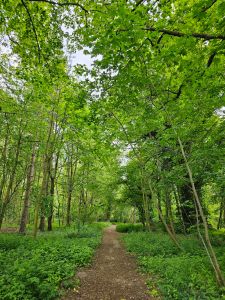
We found concrete plinths which were clearly the base of long gone nissan huts and to our amazement four in-tact air raid shelters.
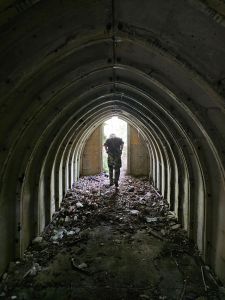
These are clearly used as drinking dens by kids these days but originally it would have been part of what McSon tells me is an airfield dispersal site.
An airfield dispersal site was exactly what it says on the tin. One site of many dispersed around the airfield to make it harder to bomb the entire infrastructure with one hit. This one is where some of the living quarters were.
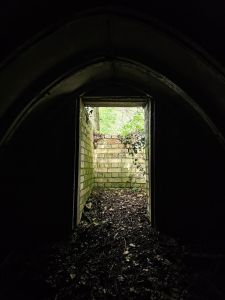
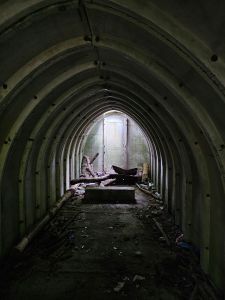
The shelters would normally have a brick well in front of them with steps that you went down to enter and one still had this, the others were simply down a steep slope. At the other end is an escape hatch.
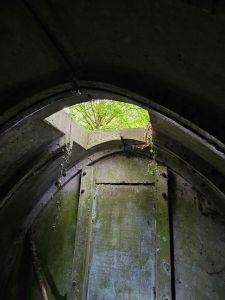
Escape hatch! There would have been a lid … and a ladder.
In one we found evidence of a wall across it at some point, with a door. In all of them there had clearly been benches or possibly bunks mounted on bricks.
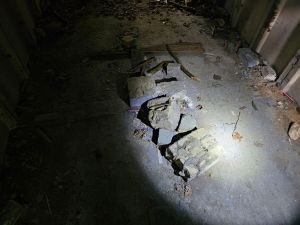
After a quick squiffy on t’interweb, McMini reckons that what we found was the blast shelters to accommodate the staff. These were called Stanton air raid shelters and were made by Stanton Ironworks in … yes, you guessed it … Stanton (quelle suprise). Each shelter would be paired with a couple of nissan huts with living quarters inside so the occupants could go there for shelter in an air raid.
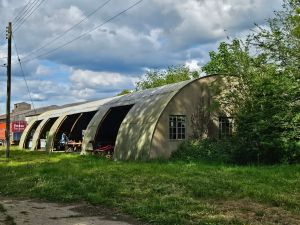
We also hoped to see a command bunker on a nearby industrial estate so we left and headed back across the A14. On our way we happened on another group of airport buildings. We ventured into the periphery of a farm yard to take photos but didn’t want to go right inside without asking the farmer for permission. Still enough close enough to photograph and very interesting. McMini is still researching what those buildings were for but there were clearly a couple of aircraft hangers at the far end.
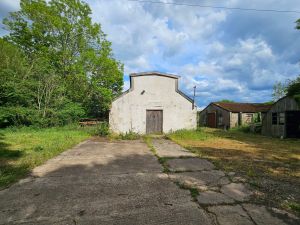 When we got to the area where the command bunker is sited we discovered that, unfortunately the land was fenced off, either because they were building next to it or because there were game birds in the woods in front of it. In case it was the latter, we decided not to go and find it without seeking permission first, so after a quick walk down what was clearly a taxiway of some description, we gave up on seeing that and came home.
On the way we saw some discarded? or possibly spare plane parts. The engine cowlings would make a great spa for nerds we reckoned!
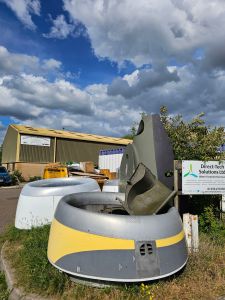
All in all a splendidly nerdy afternoon. Helped by the fact McMini is a very knowledgeable and makes for great tour guide!





They were so brave. Just going underground to an air-raid shelter would have freaked me out.
It’s surprisingly unfreaky when you’re there. The photos are a lot more eerie than the shelters felt.
Good to know.
Hi,
Interesting post! I have a few comments:
I like the McSon designation. Great replacement for the younger McMini.
Please tell me that you didn’t compose that whole thing in the 10 minutes you had available. I am absolutely certain that it will take me about that long to finish this reply — and it won’t be nearly as interesting and coherent as your post.
There are many days when I wish I lived somewhere with a bit more history attached. My brother has a metal detector, but he is not well enough to be interested in taking it out of storage and actually using it, even if he wanted to (which he may or may not). And I am not exactly sure where we might take it to give it any chance of finding interesting items.
The only things I have noticed in our part of the world that are even remotely similar to the locations you explored are a couple of gun towers at one of the beaches that are at the entrance to the bay (English Bay) that Vancouver is located on. I have seen one, but I don’t think they are accessible(ie to go inside) and are pretty solid — the gunning spots are on the second floor of the round cement (I think) towers, and I am pretty sure neither of them — I think there are two — have had an actual weapon inside since the mid 1950’s — if that.
(Note it’s taken me 10 minutes to type this far, and now I am going to detour to see what I can discover about the gunning towers.)
Well… I am back! And the first link I found informed me of a whole lot of stuff I had no idea about!
You might enjoy this informative video, too, so here is the link: oops, no link because I don’t know how to find the links my Mac computer shows me: Instead, please do a search– if you are interested — for Abandoned WWll buildings: Point Grey Battery : r/vancouver (I suspect you won’t need the : r/vancouver bit)
In case you are interested, the towers, that I was sure were gunning towers, were not. They actually “only” held remotely controlled search lights that scanned the bay for invading ships. The guns were planted nearby, and I think they were only shot once. But I don’t think the narrator mentioned what they were aimed at.
The towers make an appearance at about the 4 minute mark in the video, but the earlier bit is very interesting, too.
I did walk to one of the towers when I was younger — reached by walking along the beach — not via any staircase.
And I have been to the museum of Anthropology — and in fact was there when they did the official totem pole raising when the museum was first opened. I had NO idea that the clamshell people carving was located on anything related to a gun turret.
The things you learn when investigating local stuff after reading about interesting posts from other parts of the world…..
You should visit Vancouver sometime. It can be really lovely here sometimes (often, in fact), and my favourite beach in the city (we have LOTS of beaches in the city) is not too far from this one — which is why we can walk to the turrets/towers if we want to.
Oh — and one final detail: the last time I saw the towers they had no graffitti on them and were a lovely unceremonious grey. Shows how long it’s been since I walked in that direction..
On that note — many many minutes more than 10 later, I will now sign off.
Thank you for your posts. I almost always learn something new in each one.
Blessings on you and your family!
Diana
Wow! Thanks for all of that info. I will definitely go and have a look. And yes, it actually took me 40 mins in the end, although the main bit was still adding the pictures, inserting them and adding alt text. Alt text descriptions are the bane of my life as I always make them too long or whatever and you can’t always see in the box what you’ve typed or are typing!
May 18, 2026
Howfascinating, MT! Being a history buff myself, I devoured every word. Then, being a parent and now grandparent, I thought: How wonderful that you and McMini can share such activities together. And that he seems to know more than you on this topic! (Though he may be taller than you now, and you may have to start calling him McTaller. But I digress.)
Reading your post made me think of Foyle’s War. I watched every episode of every season last year, and loved it, fascinated with the thought that many of the episodes were based on real places and events.
Bless you, thanks. We are, indeed, lucky with McSon. And I never knew that about Foyles War. That’s cool.
May 27, 2026